Researched by
Based on CHITU Systems product and policy pages, independent reviews by The Gadgeteer and Hackaday, and owner videos read on November 14, 2026; not a hands-on test by this site.
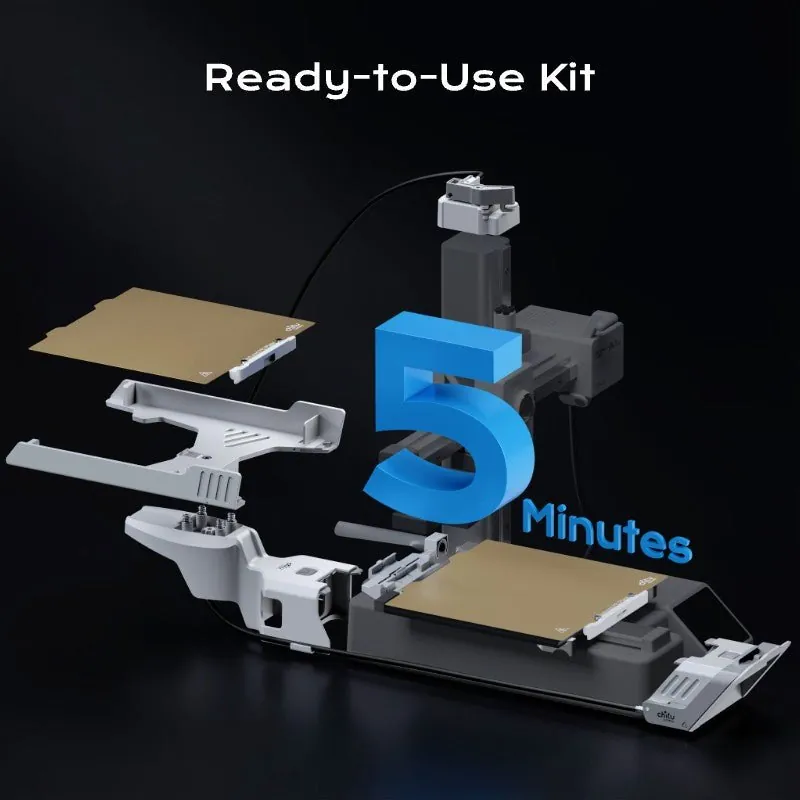
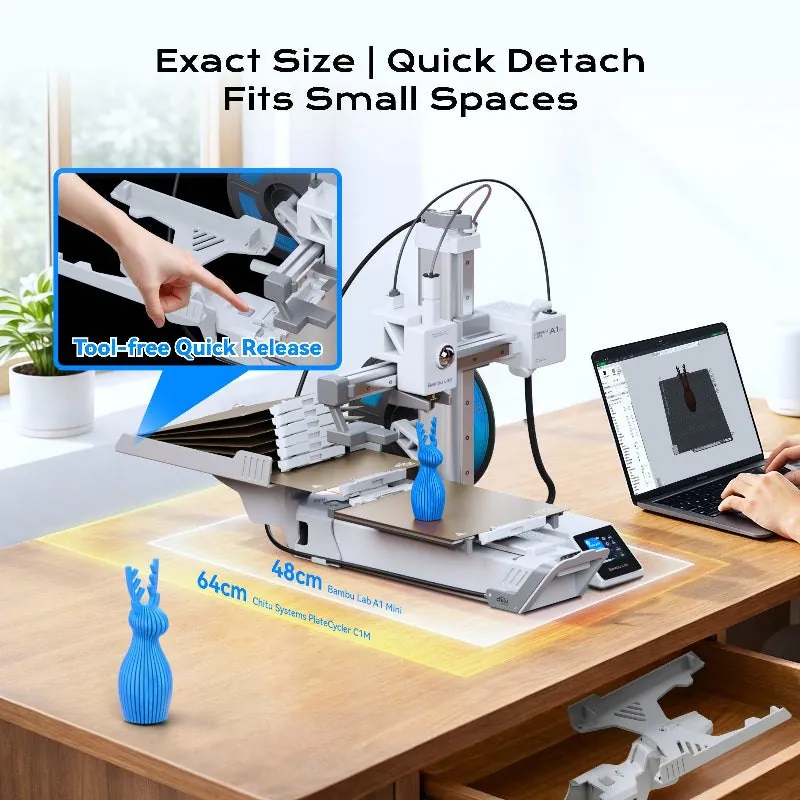
The PlateCycler C1M is a bolt-on kit for the Bambu Lab A1 Mini 3D printer. It pushes off a finished build plate and pulls in a fresh one, so the printer can run plate after plate on its own. It is fully mechanical, holds up to 10 plates and comes with four. This PlateCycler C1M review is for A1 Mini owners who print small parts in batches.
PlateCycler C1M review: the score
Research score: 7.0 / 10 (provisional)
The Gadgeteer ran it for weeks of non-stop printing without a failed swap, and Hackaday’s summary of a video test calls setup fairly painless. It loses points for fiddly tray-height tuning, plates that crash into a bin, a fit limited to one printer, and a design Hackaday calls a clone of an earlier kit.
Researched from public evidence, not hands-on testing. Store and service problems are rated separately as the store risk. How scores work
How the C1M works
The kit adds a sloped tray behind the bed, a gripper on the back of the heatbed, an ejector on the front and a lever lifter on top. Between jobs, the print head and bed move in a set pattern. That motion lifts the finished plate off the magnetic bed and drags the next plate from the tray.
Nothing connects to the printer’s electronics. Instead, you slice in Bambu Studio and run the file through CHITU’s web converter or offline app, which inserts the swap moves into the G-code. Hackster notes that a mechanical design also avoids worries about future Bambu firmware updates.
| Detail | PlateCycler C1M (CHITU figures) |
|---|---|
| Printer | Bambu Lab A1 Mini only |
| Plates | 4 double-sided textured PEI plates included; tray holds up to 10 |
| Power and wiring | None; fully mechanical |
| Files | Web converter or Windows app adds the swap G-code |
| Materials | Injection-molded parts, some reinforced with 20% glass fiber |
| Adjustment | Screw-and-spring tray height |
| Third-party plates | Possible after drilling holes and adding a printable hook |
What independent testers found
The Gadgeteer reviewer, who runs a small print business, used a free sample on a new A1 Mini. After weeks of round-the-clock printing it had no swap failures, and he only reset the printer about every three days. He found installation fairly easy with CHITU’s written guide and video, and liked the converter’s time and filament totals.
Getting the tray height right mattered most. If it sits too high the gripper misses the plate, and too low it collides. CHITU supplies a test file that cycles all plates without printing.
Hackaday summed up a test by the Aurora Tech YouTube channel. A small tolerance problem stopped the last plate from loading until the tester sanded it. Otherwise it was fairly painless, and Hackaday called the price not unreasonable for a kit that includes four PEI plates.
Where it falls short
- Plate pile-up. Finished plates drop into a padded bin. Hackaday notes that after the first one or two, plates with parts land on top of each other.
- Tall or fragile prints. CHITU itself warns against tall, thin or delicate models that may break when the plate falls.
- One printer. The C1M fits only the A1 Mini; the full-size A1 needs the separate C1.
- Design origin. Hackaday says it is effectively a clone of the earlier Swapmod kit, though CHITU ships every part instead of asking you to print some.
- Warranty terms. The store’s policy spells out a one-year warranty for control boards and screens but says nothing specific about the PlateCycler.

How it compares
| Option | What it is | Independent coverage | Best for |
|---|---|---|---|
| PlateCycler C1M | Complete mechanical kit for the A1 Mini, 4 plates, up to 10 | The Gadgeteer, Hackaday | Plug-in batch printing on an A1 Mini |
| PlateCycler C1 | The same idea for the full-size A1, up to 8 plates per run | Hackster launch report | Larger parts on the A1 |
| Swapmod kit | Earlier plate-swap kit; some parts printed by the owner | All3DP Kickstarter report | Makers happy to print and assemble parts |
| No changer | Swap plates by hand between prints | Not applicable | Occasional one-off prints |
Decision factors
- Print size. It pays off for many small, sturdy parts, such as Etsy or Amazon stock, not for single large models.
- Setup patience. Plan time to tune the tray height and run the test file before trusting it overnight.
- Space. You need room in front of the printer for a padded bin.
- AMS Lite. The Gadgeteer notes the kit moves the filament tube, a step that does not apply with an AMS Lite.
Who should skip it
Skip the PlateCycler C1M if you own any printer other than an A1 Mini, mostly print tall or delicate models, or rarely queue more than one job. Skip it too if you want a long, written warranty for the kit itself.
For shipping, returns and store ratings, see the CHITU Systems brand review.
PlateCycler C1M FAQ
Does the PlateCycler C1M work with the full-size Bambu Lab A1?
No. CHITU says the PlateCycler C1M fits only the Bambu Lab A1 Mini. For the full-size A1, CHITU sells the separate PlateCycler C1, which Hackster reports holds up to eight plates per run.
Do I need special software for the PlateCycler C1M?
You slice normally in Bambu Studio, then run the file through CHITU’s free web converter or Windows app. It adds the plate-swap moves to the G-code and shows total print time and filament use.
How many plates can the PlateCycler C1M hold?
The PlateCycler C1M tray holds up to 10 build plates. The kit includes four double-sided textured PEI plates, and CHITU sells extra plates in packs of four.
Sources
- CHITU Systems PlateCycler C1M product page and FAQ, PlateCycler C1 page, refund and warranty policy (read November 14, 2026)
- The Gadgeteer: PlateCycler C1M review (November 12, 2025)
- Hackaday: testing a continuous printing mod for the Bambu Lab A1 Mini (January 16, 2026)
- Hackster: the PlateCycler is coming to the Bambu A1
- All3DP: the Swapmod Kickstarter for the A1 Mini
Prices and offers change often, so check the brand’s site for current details.