Researched by
Based on Fosi Audio product and policy pages, independent bench tests and listening reviews read on November 14, 2026; not a hands-on test by this site.
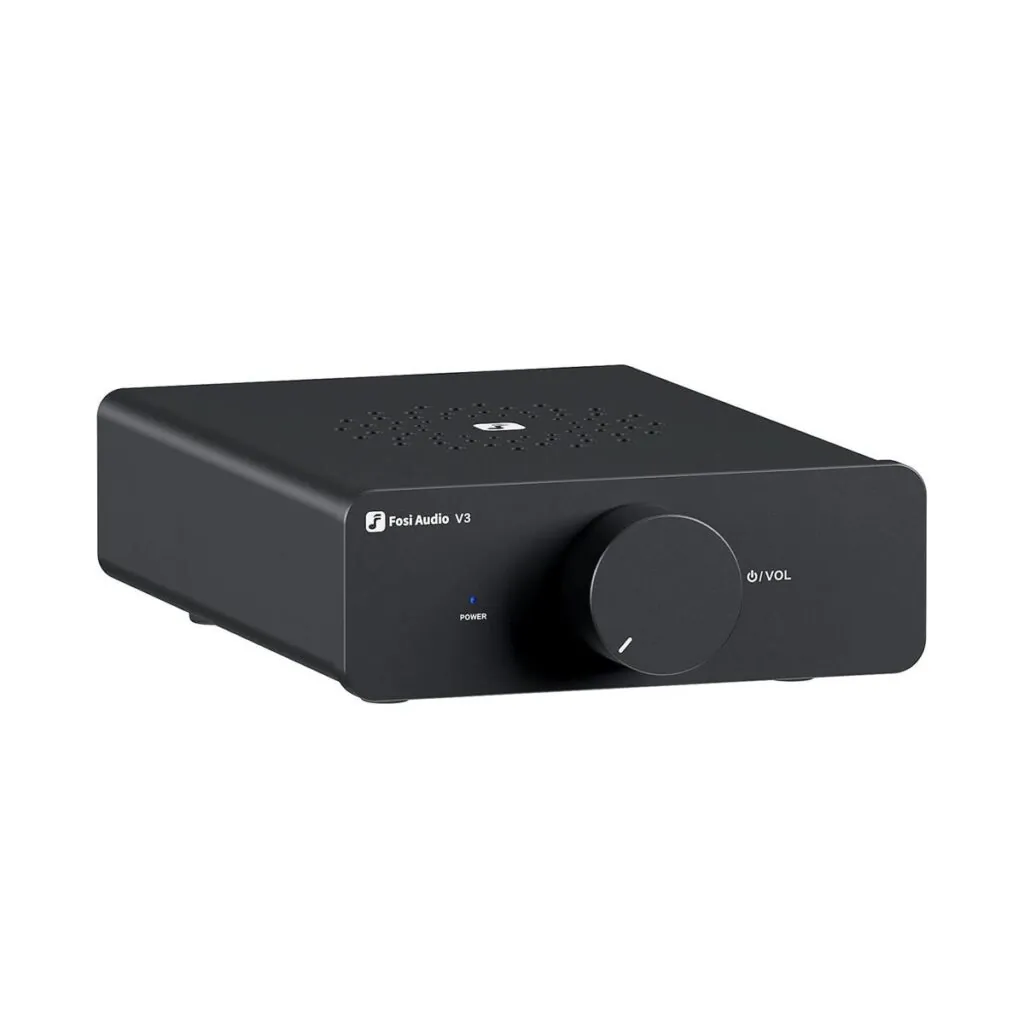
The Fosi Audio V3 is a compact class D stereo power amplifier built on the Texas Instruments TPA3255 chip. It drives a pair of passive speakers from one RCA input and has a single volume knob. This Fosi Audio V3 review is for desktop and bookshelf listeners who want clean power and already own a source with its own controls.
Fosi Audio V3 review: the score
Research score: 7.6 / 10 (provisional)
Audio Science Review measured about 88 dB SINAD and recommended it, and the all-metal case stayed only warm at full power. It loses points because real output is far below the 300-watt claim, treble shifts with speaker load, and there is only one RCA input.
Researched from public evidence, not hands-on testing. Store and service problems are rated separately as the store risk. How scores work
Specs at a glance
| Spec | Fosi Audio V3 (Fosi figures) |
|---|---|
| Amplifier chip | TI TPA3255, class D |
| Claimed max power | 300 watts x 2 into 4 ohms (needs the 48-volt supply) |
| Supported loads | 2 to 8 ohms |
| Inputs and outputs | One RCA input; speaker terminals; pre-out |
| Claimed noise and distortion | SINAD 88 dB, SNR 110 dB or more, THD 0.003% |
| Power supply options | 32 V/5 A, 48 V/5 A, GaN 48 V/5 A, or amp only |
| Size and weight | 6.5 x 4.1 x 1.4 inches; about 1.2 pounds |
| Warranty | 24 months, plus a 30-day money-back window |
What the bench tests show
Audio Science Review tested the V3 in June 2023 on a sample Fosi sent. Distortion sat near -100 dB, so noise set the SINAD at about 88 dB. The reviewer called that well above average for amplifiers he had measured, and he recommended the amp.
The same test found load dependence, common to budget class D amps. Into 8-ohm speakers, response rose or fell near 20 kHz depending on the load, so some speakers may sound slightly bright. Pragmatic Audio flagged the same issue and suggests tone control or EQ upstream to correct it.
Two smaller notes came from the ASR unit. One large capacitor had come unglued and rattled inside, without damage. The amp made a mild pop at power on and off.
The 300-watt claim and which power supply to buy
Fosi quotes 300 watts per channel into 4 ohms, a figure that only applies with a 48-volt supply at the chip’s limit. Audioreviews.org cites ASR at about 38 watts into 8 ohms with the stock 32-volt supply. Its reviewer called the 300 to 600 watt claims “nonsensical.”
ASR measured clearly more power with the 48-volt supply, especially into 8 ohms, and advised buyers to choose it. Pragmatic Audio adds that the 32-volt kit is enough for most listeners with efficient speakers. In audioreviews.org listening, the V3 sounded clean but thin on power-hungry Revel bookshelf speakers.
Setup, inputs and controls
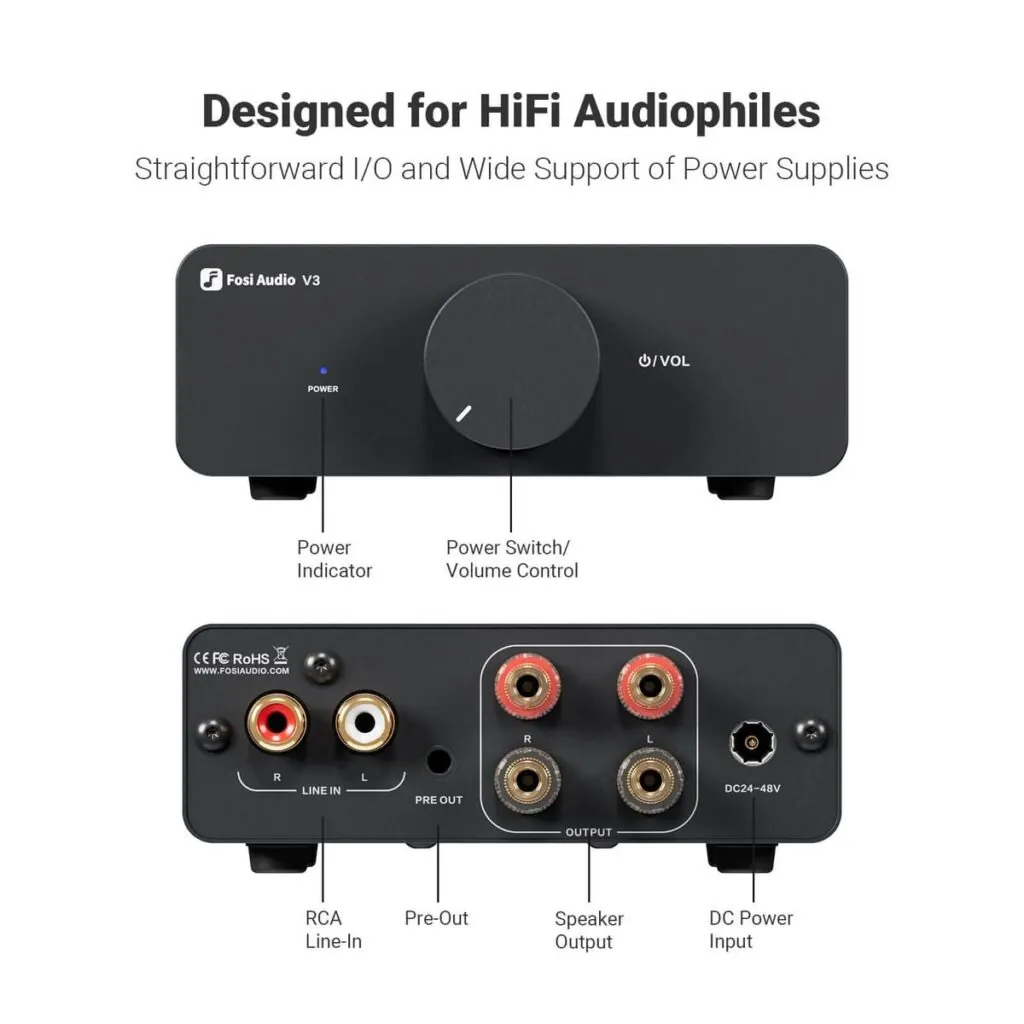
- One analog input. The V3 takes a single RCA pair, so a DAC, preamp or turntable with a phono stage feeds it.
- No tone controls or Bluetooth. The only control is a log-taper volume knob that doubles as the power switch.
- Pre-out. Fosi lists a pre-out with volume control. PC Perspective relayed a buyer report that it behaves as a fixed line out, so check before planning a subwoofer.
- Op-amp swaps. The two NE5532 op-amps sit in sockets, so you can swap them.
- Heat. The chip is bonded to the aluminum case. ASR reported it only got warm to the touch after repeated full-power runs.
How it compares
| Option | What it adds or drops | Independent coverage | Best for |
|---|---|---|---|
| Fosi Audio V3 | One RCA input, no tone controls | ASR: about 88 dB SINAD, recommended | Clean power behind a DAC or preamp |
| Fosi Audio BT20A Pro | Adds Bluetooth, bass and treble knobs | Wirecutter pick: 44 W into 8 ohms, 77.3 W into 4 ohms | One box for phone streaming and speakers |
| Fosi Audio V3 Mono | One amp per speaker; RCA, XLR and TRS inputs; post-filter feedback | Fosi says the feedback design reduces load dependence | Bigger speakers and balanced sources |
Pick the V3 if your source already handles volume and streaming; pick the BT20A Pro if your phone is the source.

Decision factors
- Speaker sensitivity. Speakers rated near 88 dB or higher suit the 32-volt kit; low-sensitivity or 4-ohm speakers favor the 48-volt supply.
- Source. You need a DAC, streamer or preamp with RCA out, since the V3 has no digital or wireless input.
- Brightness. If your speakers already sound bright, plan on EQ, given the load dependence ASR measured.
Who should skip it
Skip the V3 if you want one box with Bluetooth, tone controls or several inputs; the BT20A Pro or a receiver fits better. Skip it too for low-sensitivity speakers in a large room, where reviewers found it ran short of headroom.
For returns, warranty, shipping and store ratings across the brand, see the Fosi Audio brand review.
Fosi Audio V3 FAQ
How many watts does the Fosi Audio V3 deliver in tests?
Far fewer than the 300-watt label. Audioreviews.org cites Audio Science Review at about 38 watts per channel into 8 ohms with the stock 32-volt supply. The Fosi Audio V3 delivers clearly more with the 48-volt supply.
Should I buy the Fosi V3 with the 32V or 48V power supply?
Audio Science Review recommends the 48-volt supply because the Fosi Audio V3 measured much more power with it, especially into 8-ohm speakers. The 32-volt kit is enough for efficient bookshelf or desktop speakers at moderate volume.
Does the Fosi Audio V3 have Bluetooth or tone controls?
No. The Fosi Audio V3 has one RCA input and a volume knob only. Fosi’s BT20A Pro uses the same TPA3255 chip and adds Bluetooth plus bass and treble controls.
Sources
- Fosi Audio V3 product page, refund policy and shipping policy (read November 14, 2026)
- Audio Science Review: Fosi Audio V3 amplifier review (June 20, 2023)
- Pragmatic Audio: Fosi Audio V3 (August 7, 2023)
- PC Perspective: Fosi Audio V3, Revenge of the Class D Amp (June 26, 2023)
- Audioreviews.org: Fosi Audio V3 amplifier review, second opinion (March 22, 2024)
- Wirecutter: the best stereo amplifiers and receivers (updated September 2, 2026)
Prices and offers change often, so check the brand’s site for current details.