Researched by
Based on published specifications, independent tests and owner reports read on October 6, 2026; not a hands-on test, and not installation advice. Connecting a power station to a home or RV electrical system should follow the manufacturer’s manual and local rules; a qualified electrician can help.
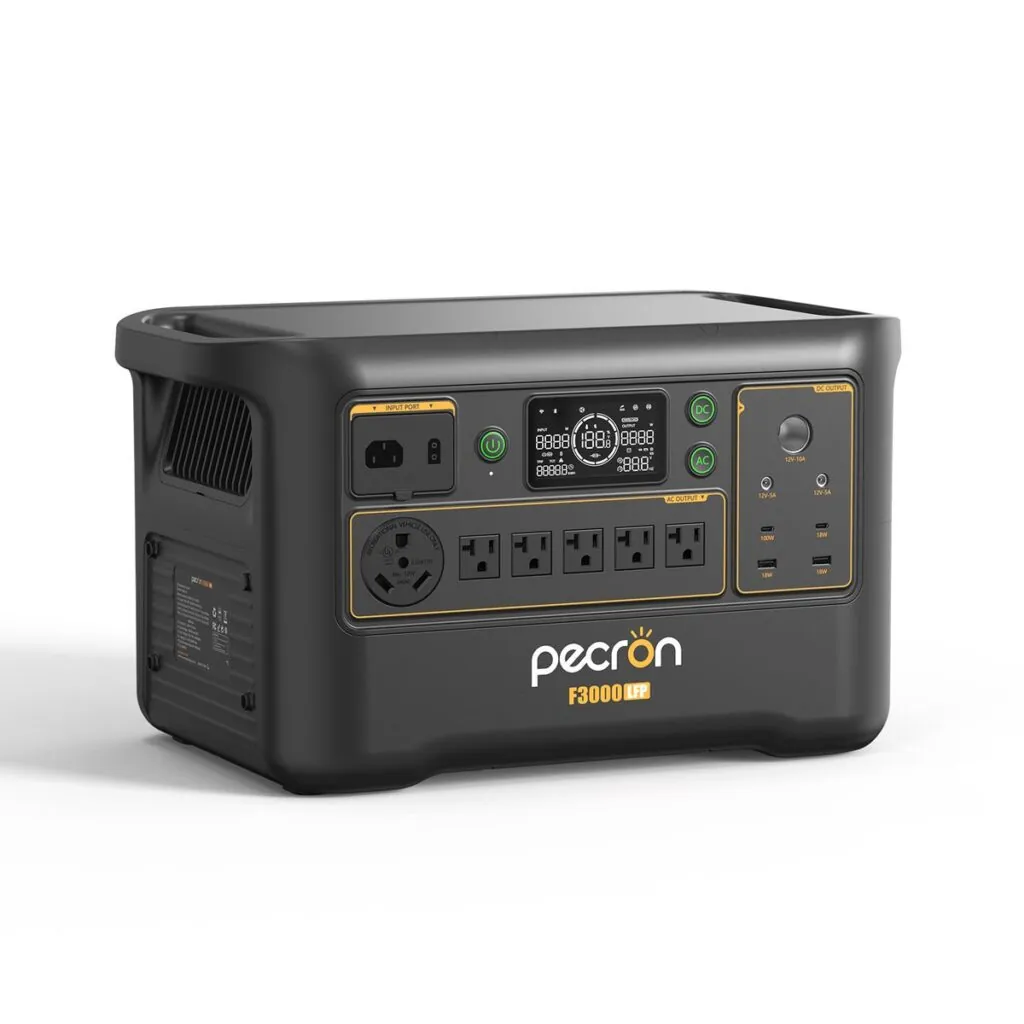
The Pecron F3000LFP stores the same 3,072 Wh as the E3600LFP but is built for speed and lower weight: a 1,800W AC input that refills it in about two hours, up to 1,600W of solar, a 3,600W inverter and app control. It is the version to look at if the E3600LFP’s 79 lb is a deal-breaker.
Where it differs from the E3600LFP
- Lighter: about 63 lb (from third-party listings) versus about 79 lb.
- Fewer ports and less solar: 13 outputs and up to 1,600W of solar, versus 16 outputs and 2,400W.
- Lower surge: 4,500W for five seconds, versus 7,000W.
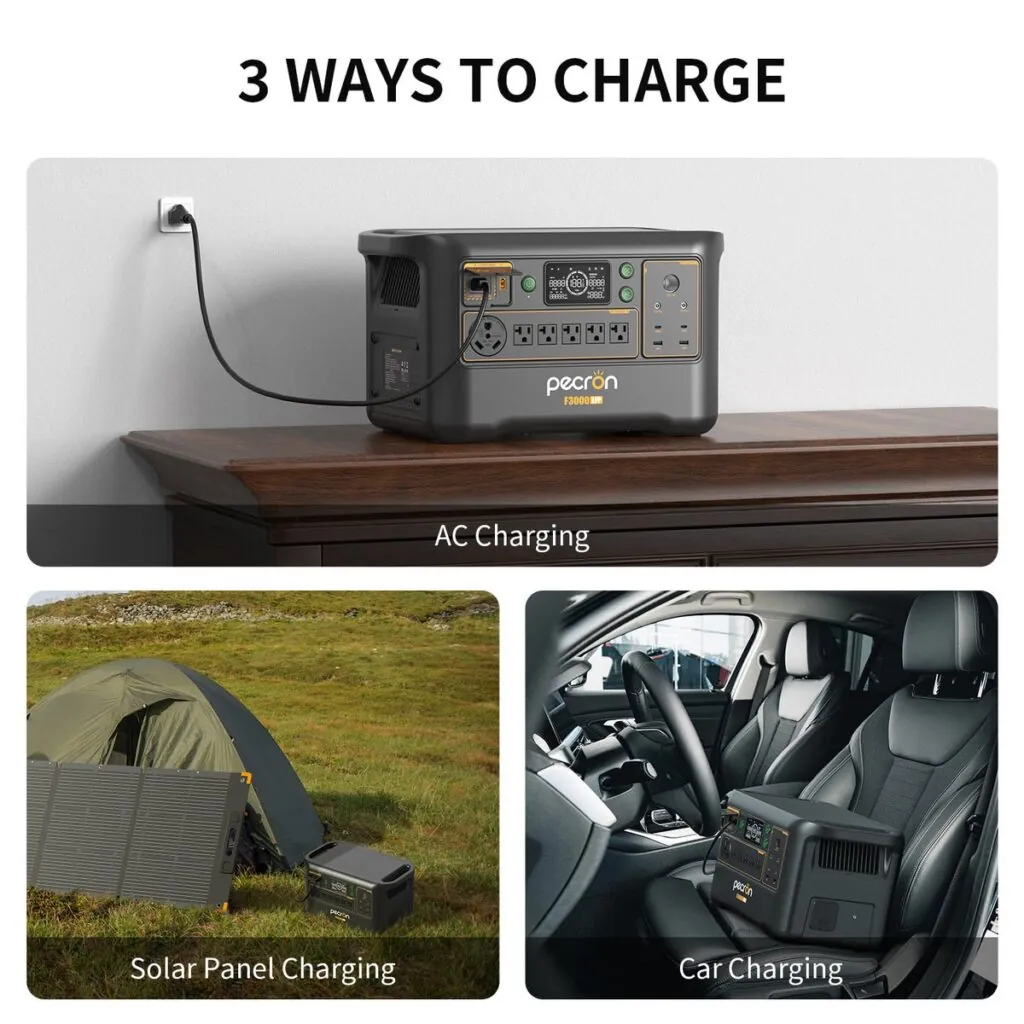
- Charging: 1,800W from AC in about 2 hours.
- Product score: 7.7/10, provisional; store risk is shown separately.
Specifications
| Spec | Pecron F3000LFP |
|---|---|
| Capacity | 3,072Wh |
| Output | 3,600W bidirectional pure sine wave (4,500W surge for 5s); AC 30A; 13 outputs; USB-C PD 100W |
| Charging | 1,800W AC (about 2 hours); up to 1,600W solar; up to 3,200W AC plus solar in about 1.3 hours (brand) |
| Battery | LiFePO4, 3,500+ cycles to 80% (brand) |
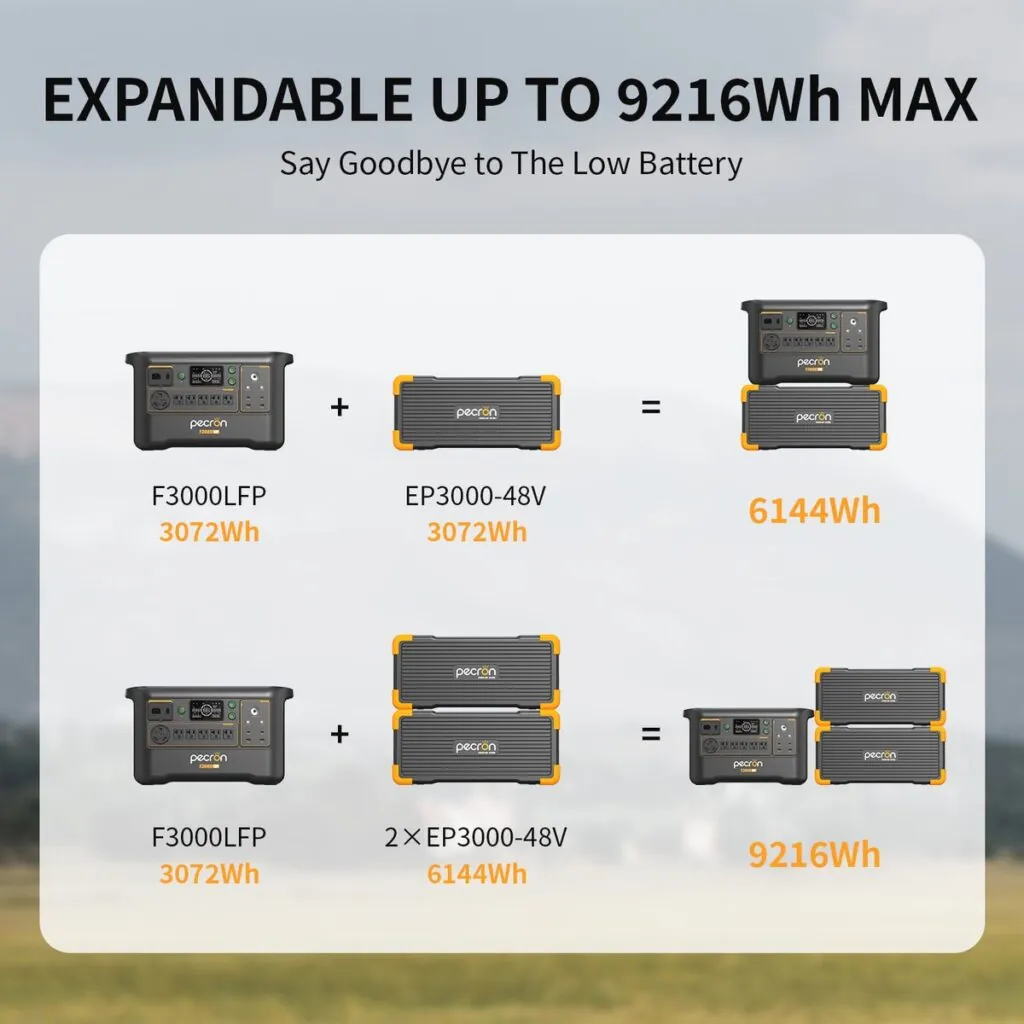
| Expansion | Up to 9,216Wh with 2 × EP3000-48V (brand) |
| Control | App control over Wi-Fi and Bluetooth; UPS |
| Warranty | 2+3 years (brand) |
| Weight | About 63.3 lb, per a third-party review listing |
What reviewers report
Search-result summaries of The Solar Lab, Battery Essence, Best Batteries and Solar Power Picks agree on the broad picture: at a sustained 3,600W load the unit averaged about 83% efficiency, a UPS mode switches in roughly 8 to 20 ms, and it is compact for a 3 kWh unit but still heavy to move. The cons they list: the expansion battery cable is sold separately, a car charger is not included, and some owners complain about the app (pairing, Wi-Fi setup, account login and unclear settings) feeling less polished than EcoFlow’s. On value, one summary puts Pecron at roughly 20 to 30% more watt-hours per dollar than Jackery and Bluetti at similar capacities, while EcoFlow and Anker offer smoother apps.
A year later
Long-term ownership matters more for a battery system than a first-week test. The video above is a one-year follow-up from The Solar Lab Plus and a good place to see how the unit has held up. I have not watched it in full, so I am not summarising its conclusions here; check it against the Trustpilot picture: Pecron has Trustpilot 3.6/5 from 53 reviews (read October 6, 2026), with complaints about defects, slow replacements and late accessories.
Versus the E3600LFP and EcoFlow DELTA Pro
| Pecron F3000LFP | Pecron E3600LFP | EcoFlow DELTA Pro | |
|---|---|---|---|
| Capacity | 3,072Wh | 3,072Wh | 3,600Wh |
| AC output | 3,600W (4,500W surge) | 3,600W (7,000W surge) | 3,600W (7,200W peak) |
| Weight | About 63.3 lb (third party) | About 79 lb | About 99 lb |
| Solar input | Up to 1,600W | Up to 2,400W | Not listed in my sources |
| Warranty | 2+3 years | 2+3 years | 3+2 years |
Figures come from product pages and a third-party listing and may vary by variant. See our E3600LFP review.
Who should buy it, and who should skip it
Buy it if you want 3 kWh of backup power in a lighter, faster-charging unit and you do not need the E3600LFP’s extra ports or solar input.
Skip it if you need a very polished app, a long standard warranty (the brand lists 2+3 years), or the biggest solar input.
Questions people ask
How is the F3000LFP different from the E3600LFP?
Same 3,072 Wh, but lighter, with fewer outputs, a lower surge rating and less solar input.
Can it be expanded?
Yes, up to 9,216 Wh with two EP3000-48V batteries, per the brand.
How long does it take to charge?
About 2 hours from the wall at 1,800W, and the brand says about 1.3 hours using AC plus solar together.
My take and score
Research score: 7.7 / 10 (provisional)
Good efficiency and charging speed in reviews, lowered for app complaints, separately sold accessories and a short standard warranty.
Researched from public evidence, not hands-on testing. Store and service problems are rated separately as the store risk. How scores work
Sources
- The Solar Lab (listed in search results)
- Battery Essence (listed in search results)
- Best Batteries (listed in search results)
- Solar Power Picks (listed in search results)
- Trustpilot: Pecron reviews (read October 6, 2026)
- Pecron product page (pecron.com)
- Brand overview: Pecron on Jensolnar
Prices and availability change often, so check the retailer for current details.