Researched by
Based on published specifications and independent reviews with measurements, read on October 12, 2026; not a hands-on test by this site. A Raspberry Pi 5, NVMe drive and power supply are sold separately.
SunFounder Pironman 5 review: who this case is for
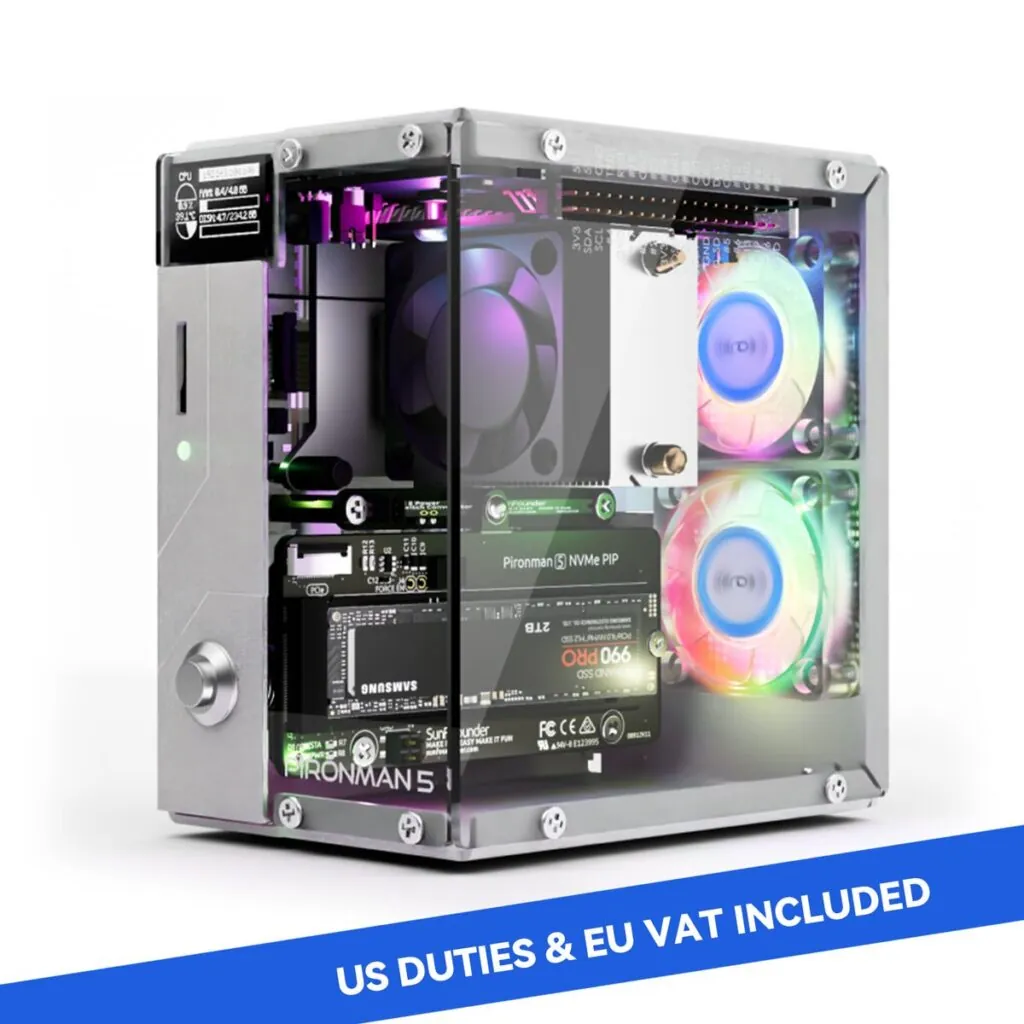
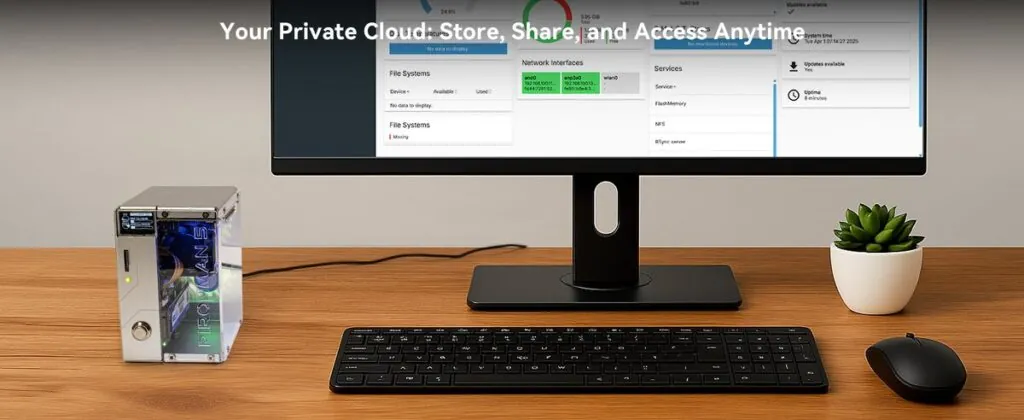
The Raspberry Pi 5 runs hot and has no built-in NVMe slot. The Pironman 5 fixes both and turns the board into a small tower PC: an aluminum case with a tower cooler, two RGB fans, an M.2 slot, full-size HDMI ports and a small status screen. It makes sense if your Pi will run all day as a desktop, a home server or a media box. For a Pi that lives in a drawer and runs one script, it is more case than you need.
Specifications
| Spec | SunFounder Pironman 5 |
|---|---|
| Board | Raspberry Pi 5 (not included) |
| Storage | M.2 NVMe slot for 2230, 2242, 2260 and 2280 drives; PCIe Gen 2 by default, Gen 3 can be enabled; also fits a Hailo-8L AI module |
| Cooling | Tower cooler with 40 mm fan plus two rear 40 mm RGB fans with dust filters |
| Display | 0.96″ OLED: CPU and RAM use, temperature, IP address, disk use |
| Ports | Two full-size HDMI, USB-C power and microSD moved to the front and back; external GPIO extender; IR receiver |
| Power | Front power button with safe shutdown |
| Body | Aluminum frame with clear side panels |
| Assembly | About 45 minutes for a first build (bret.dk) |
Thermals and storage: what the tests measured
| Test | bret.dk | Liliputing |
|---|---|---|
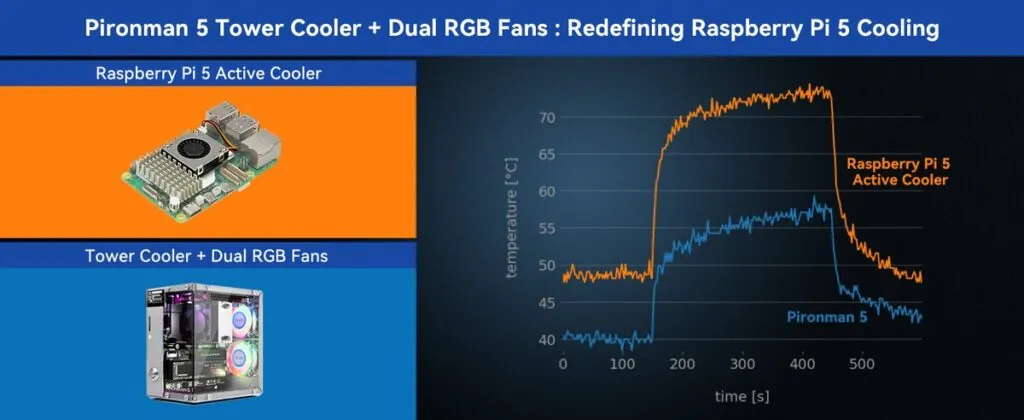
| Idle CPU temperature | 32.9 °C (24 °C room) | Just over 40 °C (17.8 °C room) |
| Full-load CPU temperature | 53.5 °C, no throttling | Under 61 °C over 20 minutes, held 2.4 GHz |
| Fan behavior | Rear RGB fans start near 60 °C | Fan steps up at 50 °C and 60 °C; rear fans about 45 dBA |
| NVMe speed | Tested at Gen 3 | About 468 MB/s read (Gen 2), about 926 MB/s read and 818 MB/s write (Gen 3) |
Both reviews used the base Pironman 5. Room temperatures differ, so compare within each column, not across them.
The takeaway is consistent: the Pi 5 never throttled under sustained load, and NVMe storage runs roughly ten times faster than the microSD card Liliputing tested (about 91 MB/s read). The monitoring software that drives the OLED and fans used about 2 to 3% of CPU in bret.dk’s test.
What reviewers did not like
- Wi-Fi: the metal shell and no external antenna weakened wireless performance in bret.dk’s test. Plan on Ethernet for a server.
- Assembly: many small parts, standoffs that are easy to mix up, fiddly fan cables, and a Pi that is hard to remove later.
- HATs: GPIO is reachable through an extender, but stacking a HAT is not practical.
- Small quality issues: bret.dk wanted better fan screws, and Liliputing’s included clock battery arrived corroded and dead.
- Noise: the rear fans are audible close up once they start.
Pironman 5 vs Pironman 5 Max vs the official Pi 5 case
| Official Pi 5 case | Pironman 5 | Pironman 5 Max | |
|---|---|---|---|
| NVMe slots | None | One | Two (RAID 1 possible) |
| Cooling | Small built-in fan | Tower cooler + 2 RGB fans | Tower cooler + fans |
| Full-size HDMI | No (micro HDMI) | Yes, two | Yes |
| Status screen | No | 0.96″ OLED | OLED |
| Best for | Basic, compact use | Desktop or single-drive server | NAS with two drives |
Pironman 5 Max details from RTL-SDR.com. I did not find a test that ran all three side by side.
Who should buy it, and who should skip it
Buy it if you want your Pi 5 as an always-on desktop, Home Assistant box or small server, you will add an NVMe drive, and you can use wired networking.
Skip it if you rely on Wi-Fi, need to stack HATs, or swap the Pi in and out often. If you need two drives, look at the Pironman 5 Max. For a learning project with the same brand, see the PiCar-X robot car kit.
Questions people ask
Does the Pironman 5 come with a Raspberry Pi?
No. The SunFounder Pironman 5 is a case only: the Raspberry Pi 5, NVMe drive, microSD card and power supply are bought separately. SunFounder sells bundles that add some of these parts.
Can I boot from the NVMe drive?
Yes. With an NVMe SSD in the Pironman 5’s M.2 slot, the Raspberry Pi 5 can boot and run from it. Liliputing did this in its review and measured about 926 MB/s reads at PCIe Gen 3, roughly ten times its microSD card.
How loud is it?
The Pironman 5 is quiet at idle, because its rear RGB fans stay off until the CPU reaches about 60 °C. Under sustained load, Liliputing measured about 45 dBA at the rear of the case.
My take and score
Research score: 8.0 / 10 (provisional)
Two independent reviews measured cooling with no throttling and real NVMe gains. It loses points for weak Wi-Fi inside the metal case, a long and fiddly assembly, no practical HAT stacking, and one dead clock battery on arrival. Store and service risk is shown separately.
Researched from public evidence, not hands-on testing. Store and service problems are rated separately as the store risk. How scores work
Sources
- bret.dk: Sunfounder Pironman 5 review (April 22, 2025, updated August 2026)
- Liliputing: Pironman 5 review by Ian W. Morrison (2024)
- RTL-SDR.com: Pironman 5 Max review
- Trustpilot: SunFounder reviews (read October 12, 2026)
- SunFounder Pironman 5 product page
- Brand overview: SunFounder on Jensolnar